
From the Mojave Road Report
The following volunteers worked on erecting desert tortoise exclusion fence around building sites at the Goffs Cultural Center; Chris Ervin, Leslie Ervin, Don Johnson, Tom Smith, Harry Ridge, John Harrington, and Phil Motz,
Saturday, December 30, 2006
Saturday, December 16, 2006
Cultural resources survey conducted
 Report by Chris Ervin
Photo by Dennis Casebier
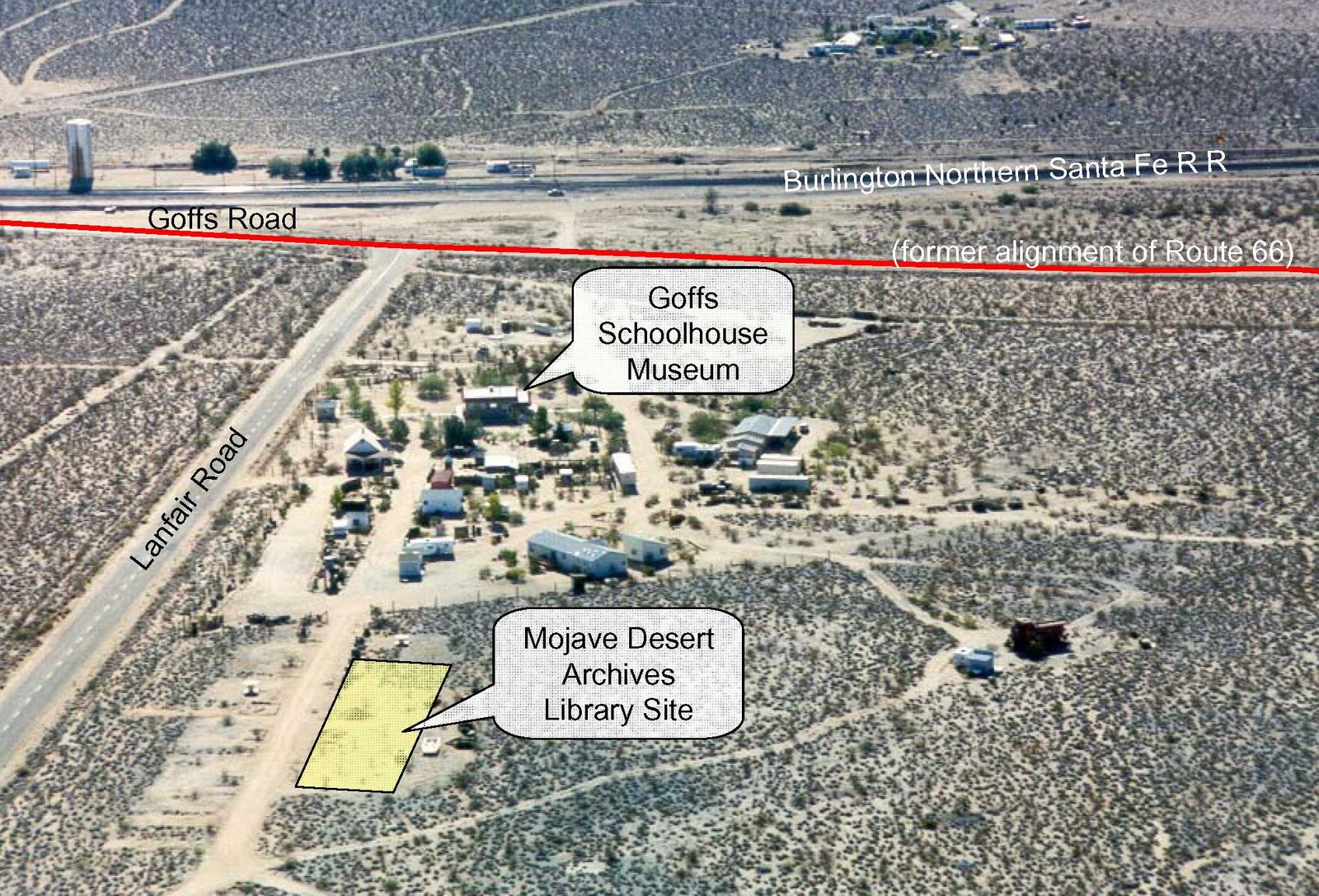
Archaeologists Russell L. Kaldenberg, MA and Judyth E. Reed, MA, walked the entire site to identify cultural resources which might occur on the footprint of the new library.
The site was intensively walked, zigzagging back and forth, looking for anything that might be over 50 years of age. The grounds were found to be neat and tidy and no scrap of any trash, debris, or negligent waste was expected.
The survey produced predictable results. No archaeological or historical materials were found within the footprint of the building site. No materials were found in any of the construction zones or laydown areas, which are adjacent to the footprint of the building, but adjoin the area to be disturbed.
No mitigation measures were recommended as there were no cultural resources, either prehistoric or historic, in or near the footprint of the building site.
This survey fulfills a County requirement for compliance with our conditional use permit and the state environmental quality act.


Tuesday, October 31, 2006
We hit the hard stuff
 Report by Dennis Casebier
Tuesday
I talked with Raymond Ward this morning. It was the first chance I've had to hear what actually happened when the rig broke down last week. They hit some really hard stuff and had gotten down to about 420 feet when they broke through into clay. So
he turned the speed up.
After about ten feet the Rotary Table broke. This is the topside mechanism that runs everything - transfers power to everything. He is having trouble getting parts. At this point it is open-ended - he don't know when he'll have the parts.
Turns out that unless he gets the parts before the 11th of November, it isn't likely he'll be back out here until after Thanksgiving ... that because he'll be gone from the area for a few weeks.
Saturday, October 28, 2006
We have water!
Report by Dennis Casebier
Saturday
We have water! The well drillers had plans to stay into the weekend. But they left early. They got down to 400 feet and something broke in the rig (topside). So they pulled all the pipe out and took the broken parts with them for repair. Supposed to be back Monday.
Saturday
We have water! The well drillers had plans to stay into the weekend. But they left early. They got down to 400 feet and something broke in the rig (topside). So they pulled all the pipe out and took the broken parts with them for repair. Supposed to be back Monday.
Tuesday, October 24, 2006
Drillers Return!
 Report by Dennis Casebier
Tuesday
The drillers (Raymond Ward and one other) came back at about 3:00 p.m. this afternoon. They are hopeful of drilling through the week. I won't be here so I have introduced the driller to Carl Weikel.
Raymond brought us a huge antique pump with engine for our garden display. Something he and his father before him used in the business for many years. It matches our decorations. Dennis
Saturday, October 14, 2006
Update on storms and well
Report by Dennis Casebier
Saturday morning
Turns out the drillers were down 315 feet when they had to quit because of approaching storm yesterday evening. That was the first storm. During the night we were hit by three other storm cells. Lots of lightning and thunder AND the total for these storms is about one inch.
Lots of water in a short time. And some hail. Water running everywhere. I've been out this morning repairing waterways with a shovel while it is still wet. The drillers were up and had the rig going by about 8:00 a.m. They got down about 100 feet yesterday and hope for at least that much today. I expect they'll go home this afternoon.
And there is the continuing concern of more storms, although it looks clear to the west. Anyway, we definitely got a rain storm ... not just a duster. We really needed it. When we went into this storm we had just a little over an inch for the entire year ... now we are over two inches. Goffs Road is washed and flooded in both directions.
Saturday morning
Turns out the drillers were down 315 feet when they had to quit because of approaching storm yesterday evening. That was the first storm. During the night we were hit by three other storm cells. Lots of lightning and thunder AND the total for these storms is about one inch.
Lots of water in a short time. And some hail. Water running everywhere. I've been out this morning repairing waterways with a shovel while it is still wet. The drillers were up and had the rig going by about 8:00 a.m. They got down about 100 feet yesterday and hope for at least that much today. I expect they'll go home this afternoon.
And there is the continuing concern of more storms, although it looks clear to the west. Anyway, we definitely got a rain storm ... not just a duster. We really needed it. When we went into this storm we had just a little over an inch for the entire year ... now we are over two inches. Goffs Road is washed and flooded in both directions.
Friday, October 13, 2006
Drillers down to 300 foot level
Report by Dennis Casebier
Friday
Drilling was slow today. When the drillers were forced to shut down at about 7:00 p.m. by an approaching storm, they were down about 300 feet.
There were storms all about during the day today but all we received was sprinkles. Then a real storm approached after dark from the south at about 7:00 p.m. Had major lightning overhead by about 7:30 p.m. We received 16/100ths of an inch in a short time. Could have been as much as 10/100ths since the rain gauge clocks 4/100ths at a time. Anyway, it was enough to make rivers and streams around the premises. It was more than a dust settler!
Friday
Drilling was slow today. When the drillers were forced to shut down at about 7:00 p.m. by an approaching storm, they were down about 300 feet.
There were storms all about during the day today but all we received was sprinkles. Then a real storm approached after dark from the south at about 7:00 p.m. Had major lightning overhead by about 7:30 p.m. We received 16/100ths of an inch in a short time. Could have been as much as 10/100ths since the rain gauge clocks 4/100ths at a time. Anyway, it was enough to make rivers and streams around the premises. It was more than a dust settler!
Thursday, October 12, 2006
Well drilling begins
 Report by Dennis Casebier
Thursday
The drillers (three men) arrived late yesterday evening and got started early this morning. Since they feel confident they know what is down there, they are drilling with mud from the beginning. That requires lots of water. They have a truck with a
big 1,500 gallon tank.
They have brought a travel trailer for sleeping. We've got it hooked up to electricity and water. It is parked next to the double toilets on the Boulevard of Dreams. Phil Motz is on top of all that.
A huge pile of gravel was delivered yesterday so it is at the ready.
They were able to start drilling mid-morning. They went down 60 feet and stopped. This is standard practice. This first 60 feet is then lined with a large steel casing. Once that's installed things will go faster. The whole thing won't take long UNLESS something goes wrong - and something usually does go wrong. Progress will depend upon how bad any mishap will be.
Wednesday, October 11, 2006
Well drillers arrive
 Report by Dennis Casebier
Wednesday evening
For the past several days - beginning last Saturday the 7th of October - Eagle Well Drilling and Pump Service of Newberry Springs has been moving equipment out here in preparation for drilling the new well. This evening after dark they arrived pulling a travel trailer that they use for living quarters on the job. They intend to begin drilling tomorrow morning.
Wednesday, October 4, 2006
New building designer plan review
Report by Dennis Casebier
Wednesday
Building Designer Paul Geissinger and wife Shari were here for three hours. After lunch John Harrington and I met in the Schoolhouse with Paul and went thoroughly through the draft of Library/Depot plans that Leggetts prepared and which Chris forwarded to us a few days ago.
Without going into specifications, the bottom line is that this isn't going to be difficult. Mr. Geissinger plans to have a revised form of the plans ready to discuss by Friday 13 October 2006. They will be reviewed by John Harrington and any Board members that want to join in.
There'll be a fee for certification by an engineer he works with. Also there'll be a fee for someone to do the heating and energy calculations.
Once the plans are completed, we'll have to take them to a truss manufacturer (one of the few things they have in Needles - I've done this before) and get truss calculations.
Then the plans go to the building inspector and he reviews and approves them and issues a permit.
John Harrington has decided to delay his trip to Michigan so he can participate in the plan review that will result in completion of the next draft by Friday 13 October 2006.
Wednesday
Building Designer Paul Geissinger and wife Shari were here for three hours. After lunch John Harrington and I met in the Schoolhouse with Paul and went thoroughly through the draft of Library/Depot plans that Leggetts prepared and which Chris forwarded to us a few days ago.
Without going into specifications, the bottom line is that this isn't going to be difficult. Mr. Geissinger plans to have a revised form of the plans ready to discuss by Friday 13 October 2006. They will be reviewed by John Harrington and any Board members that want to join in.
There'll be a fee for certification by an engineer he works with. Also there'll be a fee for someone to do the heating and energy calculations.
Once the plans are completed, we'll have to take them to a truss manufacturer (one of the few things they have in Needles - I've done this before) and get truss calculations.
Then the plans go to the building inspector and he reviews and approves them and issues a permit.
John Harrington has decided to delay his trip to Michigan so he can participate in the plan review that will result in completion of the next draft by Friday 13 October 2006.
Tuesday, July 25, 2006
Well drilling contract signed
Report by Dennis Casebier
Tuesday
Chris Ervin gained CCHE approval to award the well drilling contract to Eagle Well Drilling and Pump Service of Newberry Springs. Into today's mail, along with a down payment and the contract signed by Dennis Casebier, went a map showing where the well is to be located.
Ray Ward of Eagle Drilling said he plans to get on our project about the middle of September. To meet a County Fire requirement, we're going to need water tanks for storing 10,000 gallons of water.
Thanks to John Harrington, Phil Motz, and Carl Weikel for the field work necessary to lay out where the well is to be located.
Tuesday
Chris Ervin gained CCHE approval to award the well drilling contract to Eagle Well Drilling and Pump Service of Newberry Springs. Into today's mail, along with a down payment and the contract signed by Dennis Casebier, went a map showing where the well is to be located.
Ray Ward of Eagle Drilling said he plans to get on our project about the middle of September. To meet a County Fire requirement, we're going to need water tanks for storing 10,000 gallons of water.
Thanks to John Harrington, Phil Motz, and Carl Weikel for the field work necessary to lay out where the well is to be located.
Saturday, July 15, 2006
Mojave Desert Archives Groundbreaking

GOFFS, CA – July 15, 2006 – At long last we broke ground for the new library archives building at the Goffs Cultural Center. The structure, funded in large part by the California Cultural and Historical Endowment, is to be built in the image of the old Goffs Railroad Depot.
A nice group of long-time supporters gathered in 110+ degree heat to witness the ceremony. A brief opening statement was made by Dennis G. Casebier, Executive Director MDHCA, who introduced Chris Ervin, president of the MDHCA. President Ervin stepped to the front, made carefully selected and poignant remarks, referred to our long-standing mission, what the new building will mean to humanity, and then proceeded to remove the first shovel of dirt.
For the ceremony, Mr. Ervin made use of a specially inscribed gold-plated ceremonial shovel provided by Director John Fickewirth. The shovel will be mounted on a wall in the Schoolhouse until the library is completed and then it will adorn a wall in the reading room of the new structure.
Following Chris Ervin’s lead, each director came forward and removed a shovel of dirt, accompanied by general approval of the assembled crowd. Following that, each other person present had an opportunity to participate in the ceremony.
By then everyone was getting warm… say, HOT. So we adjourned to the air-conditioned comfort of the Schoolhouse for follow-on speeches and to await the dinner hour. In the Schoolhouse Dennis Casebier passed out mementos in the form of miniature inscribed shovels, also provided by Mr. Fickewirth for the occasion.
Once everyone was there, President Ervin proposed a toast, followed by a couple more toasts from others. The champagne and champagne flutes were provided by Chris and Leslie Ervin. Then dinner was ready. Roast beef and special beans were prepared by Master Chef Dale McBride, potato salad and cole slaw were procured from a Bullhead City caterer, and other dishes were contributed by Betty Burton and Shirley Roby.
Once everyone had enjoyed the superb dinner we all indulged in dessert, a sheet cake appropriately decorated for the occasion and provided by Gail and Donna Andress. On the way over to Goffs from Nelson, Nevada, Gail had attempted to destroy the cake when it tried to slide off the seat and he grabbed for it, but Donna rose to the occasion and protected the cake. Meanwhile, Gail had gotten a handful of icing, which, at the urging of his bride of 62 summers, he proceeded to lick off his hand, turning his tongue and inside of his mouth (so far as could be seen) bright blue.
It was a smallish but very special group that gathered to take note of this important moment. I will confess, though, that I favor the celebrations that occur when something is finished more than marking the beginning. I am very much looking forward to that day a couple of years from now when the library building stands in all its splendor with the Board of Directors and our supporters gathered to honor that achievement.
Along those thought lines, my mind went back to that day in November of 1983 when a large group of the Friends of the Mojave Road gathered on the banks of the Rio Colorado of the West, just opposite Fort Mojave. There was an oversized yellow ribbon stretched across the road. A pair of ceremonial scissors (probably a full 30” long) had been provided, and Dennis Casebier stepped up and cut the ribbon, thereby signaling publication of the first Mojave Road Guide and the opening of the old wagon road as an interpreted four-wheel drive backcountry recreation trail. Twenty-three years have passed and the Mojave Road continues to serve and inspire the public. It was a day full of pride.
And so, within two years from now, we look forward to experiencing another of those milestone moments, of which it has been our honor to have had many, when Chris Ervin steps up to the door of the new library with an oversized pair of scissors and thereby dedicates and initiates operation of the Mojave Desert Archives to the interests of mankind. I predict many of you will be there and you will share the pride in having been part of this.
Those who participated in the groundbreaking ceremony included: Gail and Donna Andress, Jere Baker, Betty Burton, Chris and Leslie Ervin, Dave Given, John Harrington, Don Johnson, Randy Kimball, Roger and Virginia Leggett, Dick and Kathy MacPherson, John and Barbara Marnell, Dale McBride, Steve and Mary Mongrain, Phil Motz, Kib and Shirley Roby, and Carl Weikel.
Tuesday, May 2, 2006
Goffs Depot model completed

Report by Chris Ervin
John Harrington has completed a beautiful model of the Goffs Depot. This talented man put in nearly 400 hours constructing this large miniature over the past five months.
The model was built using historic documents and photos. It is so detailed that the roof can be lifted from the second story to reveal rooms inside.
The long, one-story freight building attached to the two-story depot had varying lengths over the years. For reasons of practicality, a shortened manifestation of the freight building was chosen for the model.
It is truly a wonderful contribution for visualizing how the finished Library will look. The model is currently on display in the Goffs Schoolhouse Museum.
Sunday, May 29, 2005
Good news for desert history buffs
Mark Muckenfuss
Press-Enterprise
GOFFS, CA -- Historian Dennis Casebier has received a nearly $500,000 grant from the California Cultural and Historic Endowment to construct a Mojave Desert Archives Research Library on the grounds of the 75-acre Goffs Cultural Center.
The library will be built in the image of the Goffs Railway Depot, which stood near the site from 1902 to 1956. It will house more than 6,000 volumes of published works, 700 oral histories and other material pertaining to the eastern Mojave Desert.
Press-Enterprise
GOFFS, CA -- Historian Dennis Casebier has received a nearly $500,000 grant from the California Cultural and Historic Endowment to construct a Mojave Desert Archives Research Library on the grounds of the 75-acre Goffs Cultural Center.
The library will be built in the image of the Goffs Railway Depot, which stood near the site from 1902 to 1956. It will house more than 6,000 volumes of published works, 700 oral histories and other material pertaining to the eastern Mojave Desert.
Library to house desert history
 Mojave group gets grant for building
By Chuck Mueller, Staff Writer
San Bernardino Sun
GOFFS - A former railroad depot that six decades ago hosted thousands of troops training in the Mojave Desert is to be reborn as a library to house a rich collection of desert history.
Directors of the California Cultural and Historical Endowment have awarded a grant of $499,500 to build a library to hold the Mojave Desert Archives, gathered by Western historian Dennis G. Casebier during the past 50 years.
The archives, the single largest collection of historical material dealing with the Western migration and pioneering ventures in the Mojave, includes more than 6,000 volumes of published works, 50,000 photographs and 4,500 maps of the region dating to the pioneering quest for the West.
The collection is housed in various buildings at the 20-structure Goffs Cultural Center. The center includes the original Goffs School, which was built in 1914 and is now a museum, and a twice-moved dwelling constructed in 1927 that serves as a library.
It will take about two years to construct the library, which will be designed in the image of the historical Goffs railroad depot, which operated from 1902 to 1956. In the early 1940s, thousands of soldiers training in desert warfare arrived and departed from the depot, which was demolished in 1956, Casebier said.
The grant to the Mojave Desert Heritage Cultural Association, founded by Casebier and his wife, Jo Ann, in 1993, is one of 13 awarded out of 276 applications for funds through the endowment, supported by Proposition 40.
In 2002, California voters approved the Clean Water, Clean Air, Safe Neighborhood Parks and Coastal Protection Act, known as Proposition 40, to set aside $267 million for historical and cultural resource preservation.
Kevin Starr, California historian emeritus, said the endowment's mission is to document the contributions of the many groups of people who make up California. It also helps Californians to deepen their understanding of the state's history, its present society, and themselves.
"The receipt of this generous grant marks the first time we've gotten support from outside our own membership of about 800 people," Casebier said. "The bulk of the work at the Goffs Cultural Center ... has been done by volunteers from California, Arizona and Nevada."
Viewing the upcoming construction project, volunteer Chris Ervin said, "Now the work really begins."
Among the volumes in the collection at Goffs are originals of official reports of the 1853-54 Whipple expedition, which surveyed a route for a Pacific railroad across the Mojave.
"We also have the official reports and map of Edward Fitzgerald Beale, who brought camels to California from Texas in 1850," Casebier said.
"The collection includes everything related to the East Mojave, dating to 1850. There was nothing before that."
Casebier said the center acquired the volumes "one at a time and there is a story behind each one."
The volumes also include 2,000 loose subject files pertaining to individuals of interest and specific cultural sites. It also contains an extensive collection of old area newspapers, periodicals and pamphlets, and material culled from federal records in the National Archives.
"We also have compiled 700 oral histories," Casebier said. "We're constantly looking for volunteers to help us continue this important work, and are searching for desert old-timers to participate in our extensive oral history program."
Casebier, 72, a Kansan who served in the Marine Corps at Twentynine Palms for 22 years, later was employed as a Navy physicist working with guided missile systems in Corona. During visits to Washington, D.C., he frequented the Library of Congress and the National Archives, conducting research on the East Mojave.
After writing a book in 1970 about the Arizona territory, Casebier started Tales of the Mojave Road Publishing Co., which has produced 24 titles. Sixteen were authored by Casebier.
"In 1980, I started in earnest with the library collection," he said.
A year later, Casebier formed a volunteer group that continues today, called the Friends of the Mojave Road.
"We worked with the U.S. Bureau of Land Management to develop the Mojave Road and other historic trails into the back country," he said.
For this work, Casebier and the group received the bureau's highest national award for volunteer service.
Upon retiring in 1990, the Casebiers bought the old Goffs school and 113 acres around it, intent on opening a desert cultural center. Three years later, they helped found the nonprofit, tax-exempt Mojave Desert Heritage Cultural Association to take over the property.
"In 1998, Jo Ann and I deeded the school and the 1-acre school yard to the association, restoring the school to its 1914 condition," Casebier said. "In 2001, the school was listed on the National Register of Historic Places."
The Casebiers donated 70 acres of their property to the cultural association in late 2002.
Monday, May 23, 2005
State Approves $500 Thousand For Mojave Desert Archives Construction

FOR IMMEDIATE RELEASE
GOFFS, CA – May 23, 2005 –The Mojave Desert Heritage and Cultural Association (MDHCA) has received final funding approval for construction of the Mojave Desert Archives research library. The California Cultural and Historical Endowment (CCHE) Board of Directors met on May 18, 2005 in downtown Los Angeles to review the status of 33 grant finalists selected last December. The Board's resolution to grant $499,500 to the MDHCA is the only CCHE grant awarded within the County of San Bernardino and one of thirteen to be approved out of the original 276 applications.
Funds from (CCHE) will support the construction of the Mojave Desert Archives, a research library that will preserve and present the collections of the MDHCA. The library will be built on the grounds of the 75 acre Goffs Cultural Center and in the image of the historic Goffs Railway Depot (1902-1956). The objective of the Mojave Desert Archives project is to build a repository to process, protect, and make available to our community a unique, extensive and ever-increasing volume of gathered materials pertaining to Mojave Desert history.
The Mojave Desert Archives is the largest single collection of historical materials covering the American history of the Mojave Desert—a history rich in the stories of western migration and pioneering spirit. This unique collection of archival materials, formed by renowned desert historian Dennis Casebier over the last fifty years, consists of more than 6,000 volumes of published works, tens of thousands of pages of news clip files, 50,000 historical photographs, 4,500 maps of the region dating from earliest times, 2,000 loose subject files pertaining to individuals of interest and specific cultural sites, 700 oral histories, an extensive collection of old area newspapers, periodicals and pamphlets, and materials culled from federal records in the National Archives.
Proposition 40 called for the creation of the California Cultural and Historical Endowment to support the “acquisition, development, preservation, and interpretation of buildings, structures, sites, places, and artifacts that preserve and demonstrate culturally significant aspects of California's history and for grants for these purposes.” To carry out Proposition 40's mandate, the Endowment will eventually distribute $122 million of $276 million in Proposition 40 funds.
ABOUT THE MDHCA — www.mdhca.org
The mission of the Mojave Desert Heritage & Cultural Association is to research and conserve the natural and cultural history of the Mojave Desert region for the purpose of preserving and sharing these resources in perpetuity. We accomplish this through operation of a research center, library, and archives, restoration of significant structures, conservation of historic open space, interpretation of backcountry trails, and production of educational guidebooks and historical publications in concert with government agencies and people of good faith everywhere.
CONTACT INFORMATION: Chris Ervin
Mojave Desert Heritage and Cultural Association
info@mdhca.org
Saturday, December 4, 2004
Monday, June 23, 2003
Golden Tales of the Golden State
By Dr. Kevin Starr, State Librarian of California
Los Angeles Times
SACRAMENTO — Amidst all the rancor and gloom surrounding the continuing budget stalemate, the cause of California history has gotten a boost.
Tucked into Proposition 40 was a provision authorizing $267 million for cultural and historical purposes. Gov. Gray Davis and the Legislature distributed half the money last summer. The remaining $128 million was intended for the California Cultural and Historical Endowment. This unprecedented and pioneering government entity — the Smithsonian Institution of California, it might be called — was the brainchild of Marco Firebaugh (D-L.A.) in the Assembly and John Burton (D-San Francisco) in the Senate. Their bill creating the endowment passed last summer and was signed by the governor. Then in May, Davis allocated the $128 million to the program.
For historians, preservationists, librarians, archivists and activists in the more than 350 historical societies in the state, the prospect of a permanent program, at the highest levels of government, devoted to the cause of California history is a truly exhilarating possibility. In one sense, the passage of Proposition 40, which included the historical funds, was a sign of the growing desire of the peoples of California — all the peoples in their varied historical experiences — to have their story told and, in telling that story, to assemble the larger narrative of California.
Thirty-four years ago, I completed my doctorate with an emphasis on the cultural history of California. There could be no greater contrast between our collective sense of California history — whether in the classroom or the popular imagination — then and now. The history of that time dealt with the Spanish and Mexican borderlands, followed by the Mission era, the Gold Rush and the creation of a predominately Anglo American state. While this history paid attention to literature, it was only in the first stages of acknowledging art, architecture and related cultural topics as historical forces. The stream of publications dealing with California was small but steady.
Today — thanks, in part, to a new generation of historians but also to the growing diversity of the state — the story of California has branched into dozens of directions. As befits a global culture, the history of our ethnic and cultural traditions has become a flourishing enterprise, as has the history of women in California. Historians pay closer attention to material culture and everyday life, to the role of technology, to education, art, architecture, gardening and landscape design, urban design and city-making, engineering and public works — and the all-important history of our environment. The publication stream has become a torrent. Equally impressive as formal scholarship is the rise of historical and preservationist activism at the statewide and local levels. We are entering, in fact, a golden age of historical awareness and activism.
Still, is it an exaggeration to compare the California Cultural and Historical Endowment to the Smithsonian Institution in Washington or the National Trust in Britain, or our own National Trust for Historic Preservation? Yes and no. Yes, this program will be dealing with large and important issues of cultural development. But it will be chiefly the peoples of California who will define, celebrate and preserve their histories. The Endowment must root in local historical societies and cultural groups that focus on the history and heritage of those omitted from the California story. It must see history, as much as possible, from the local perspective.
The program must be participatory but well-regulated, connected to the local level, where historical activism is so vital, yet adhering to the highest standards of statewide administration and statewide equity. But it must also be mindful of the powerful need at the core of the endowment. The people of California want their stories told, in their tragedies and triumphs, their grandeur and their textures of everyday life.
Such stories can be told through exhibitions in museums, historical societies, libraries, public galleries and similar venues. They can also be told through preservation in which significant places are set aside because they embody high and important moments in a group’s journey through identity. For some Japanese Americans, for example, the buildings in which Japanese American Army intelligence agents trained and worked in the immediate aftermath of Pearl Harbor — while most of their community was being rounded up and sent to internment camps — possess a deeply emotional and moral meaning. For African Americans in Los Angeles, there are places on Central Avenue that, though now bars or restaurants, embody the memory of jazz culture in Los Angeles and all that jazz has meant to the African American community across the decades. Caesar Chavez’s home is more than just another surviving California bungalow.
The legislation that created the California Cultural and Historical Endowment charges the State Library to develop it during in its initial phases. The State Library is already drawing up guidelines for a competitive grant process. Eventually, the endowment probably will stand on its own as a separate and continuing program.
The history and culture of California are important instances of American civilization, indeed of world culture. Now, the endowment will enable us to add many new textures and meanings to the story of California.
Dr. Starr wrote this op-ed piece to announce the beginning of a new entity in state government called the California Cultural and Historical Endowment.
Los Angeles Times
SACRAMENTO — Amidst all the rancor and gloom surrounding the continuing budget stalemate, the cause of California history has gotten a boost.
Tucked into Proposition 40 was a provision authorizing $267 million for cultural and historical purposes. Gov. Gray Davis and the Legislature distributed half the money last summer. The remaining $128 million was intended for the California Cultural and Historical Endowment. This unprecedented and pioneering government entity — the Smithsonian Institution of California, it might be called — was the brainchild of Marco Firebaugh (D-L.A.) in the Assembly and John Burton (D-San Francisco) in the Senate. Their bill creating the endowment passed last summer and was signed by the governor. Then in May, Davis allocated the $128 million to the program.
For historians, preservationists, librarians, archivists and activists in the more than 350 historical societies in the state, the prospect of a permanent program, at the highest levels of government, devoted to the cause of California history is a truly exhilarating possibility. In one sense, the passage of Proposition 40, which included the historical funds, was a sign of the growing desire of the peoples of California — all the peoples in their varied historical experiences — to have their story told and, in telling that story, to assemble the larger narrative of California.
Thirty-four years ago, I completed my doctorate with an emphasis on the cultural history of California. There could be no greater contrast between our collective sense of California history — whether in the classroom or the popular imagination — then and now. The history of that time dealt with the Spanish and Mexican borderlands, followed by the Mission era, the Gold Rush and the creation of a predominately Anglo American state. While this history paid attention to literature, it was only in the first stages of acknowledging art, architecture and related cultural topics as historical forces. The stream of publications dealing with California was small but steady.
Today — thanks, in part, to a new generation of historians but also to the growing diversity of the state — the story of California has branched into dozens of directions. As befits a global culture, the history of our ethnic and cultural traditions has become a flourishing enterprise, as has the history of women in California. Historians pay closer attention to material culture and everyday life, to the role of technology, to education, art, architecture, gardening and landscape design, urban design and city-making, engineering and public works — and the all-important history of our environment. The publication stream has become a torrent. Equally impressive as formal scholarship is the rise of historical and preservationist activism at the statewide and local levels. We are entering, in fact, a golden age of historical awareness and activism.
Still, is it an exaggeration to compare the California Cultural and Historical Endowment to the Smithsonian Institution in Washington or the National Trust in Britain, or our own National Trust for Historic Preservation? Yes and no. Yes, this program will be dealing with large and important issues of cultural development. But it will be chiefly the peoples of California who will define, celebrate and preserve their histories. The Endowment must root in local historical societies and cultural groups that focus on the history and heritage of those omitted from the California story. It must see history, as much as possible, from the local perspective.
The program must be participatory but well-regulated, connected to the local level, where historical activism is so vital, yet adhering to the highest standards of statewide administration and statewide equity. But it must also be mindful of the powerful need at the core of the endowment. The people of California want their stories told, in their tragedies and triumphs, their grandeur and their textures of everyday life.
Such stories can be told through exhibitions in museums, historical societies, libraries, public galleries and similar venues. They can also be told through preservation in which significant places are set aside because they embody high and important moments in a group’s journey through identity. For some Japanese Americans, for example, the buildings in which Japanese American Army intelligence agents trained and worked in the immediate aftermath of Pearl Harbor — while most of their community was being rounded up and sent to internment camps — possess a deeply emotional and moral meaning. For African Americans in Los Angeles, there are places on Central Avenue that, though now bars or restaurants, embody the memory of jazz culture in Los Angeles and all that jazz has meant to the African American community across the decades. Caesar Chavez’s home is more than just another surviving California bungalow.
The legislation that created the California Cultural and Historical Endowment charges the State Library to develop it during in its initial phases. The State Library is already drawing up guidelines for a competitive grant process. Eventually, the endowment probably will stand on its own as a separate and continuing program.
The history and culture of California are important instances of American civilization, indeed of world culture. Now, the endowment will enable us to add many new textures and meanings to the story of California.
Dr. Starr wrote this op-ed piece to announce the beginning of a new entity in state government called the California Cultural and Historical Endowment.
Sunday, February 7, 1999
William Andrews Clark
 |
William Andrews Clark (Union Pacific RR) |
Las Vegas Review-Journal
He left his name to Clark County, and built one of the West's more important railroads. He won fights with copper bosses and railroad robber barons. It took him perhaps 10 years to build Montana's largest fortune and not much longer to build one of America's largest business empires.
Born in a log cabin, he built America's most extraordinary mansion and gathered an important collection of European paintings.
Yet within a few years of William A. Clark's death, his empire was dismantled, his mansion razed, and in today's history, he is remembered most often for buying a seat in the U.S. Senate than for all his successes.
Clark was a gifted public speaker, but privately close-mouthed. Driven apparently by plain greed, Clark had such a Midas touch that gold rubbed off the corners of his operations, enriching people who didn't even know him.
He was born in Pennsylvania in 1839, the son of Scotch-Irish parents. When he was 17, the family moved to Iowa as homesteaders. A bright student, Clark taught school and went to law school, but never practiced.
Despite roots in Yankee Pennsylvania, Clark served the Confederate side in the Civil War. How he took his leave from an army that shot deserters, he never said. But by 1862 he was out of the South, sinking a mine shaft into the hard rock of Bob Tail Hill, Colo.
Hearing of new claims in Montana, Clark and his partners headed north, and made a small stake in a claim near Bannack.
Most prospectors who struck a little paydirt either blew it on high living or grubstaking another prospecting trip. But Clark recognized that capital, invested in a developing country, could turn a profit as fast, as large, and far more certain than panning for gold.
Journeying to Salt Lake City, he brought a wagonload of groceries back to Virginia City, Mont., and sold out immediately. The highest profits were on eggs.
"I bought case after case," he said later. "I knew they would be frozen, but they were suitable for making Tom & Jerrys." The cold-weather beverage was a favorite in Montana bars, and he sold the eggs for $3 a dozen -- at a time when miners on Nevada's Comstock, earning $4 a day, were called the highest-paid working men in America.
When a tobacco shortage loomed, he raced to Salt Lake City for a wagonload of plug-cut and twist and made another killing.
Always, he seized opportunities to provide support services to a mining economy. He became a mail contractor. He opened a mercantile in partnership with a St. Louis merchant.
Gold dust was accepted as currency in Montana, but it was unhandy. So every Sunday morning, when miners were paid, Clark showed up with cash to buy dust at $18 an ounce.
By 1872 Butte was in decline. Dust and nuggets had been panned out. There was plenty of gold left, but it was locked up in quartz ore, and there was no mill to process it. Clark bought quartz claims cheap. Finally, somebody else built a mill, but lost it in foreclosure. Clark got it, and made a fortune milling the ore of others. His own claims became doubly valuable to the man who owned the mill and didn't charge himself.
There were other men of vision in Montana, and one was Marcus Daly. He partnered with mining magnate George Hearst to buy a silver claim called the Anaconda.
The silver prospects proved unfounded, but miners uncovered a seam of copper 50 feet wide -- biggest ever found, and the basis of the great Anaconda Copper Company.
When Daly wanted to build a smelter, he found that Clark had secretly bought all the readily available water rights necessary to operate it.
Thus Clark created an able and unforgiving enemy.
In 1888 Clark sought a territorial seat in Congress on the Democratic ticket. Daly, one of four men who controlled the Democratic Party in Montana, supported a Republican.
In 1893, after Montana became a state, Clark and Daly ran for the U.S. Senate, but neither could achieve a majority in the state Legislature, which elected senators in those days, and Montana simply did without a senator.
In 1898, masked men tried to steal the ballot box in one precinct; two election officials were shot down. One died. Who ordered the raid was never proved, but when the ballots were counted there were 307 for Daly's candidates and only 17 for Clark's.
In 1899 Clark simply tried to buy the Legislature. More than one 19th-century senator had done so, including a couple who represented Nevada, but Clark got caught red-handed when a legislator dumped $30,000 before his fellow members and declared it had been advanced to him and three others for their votes. Members called for a grand jury.
Clark was able to explain away even this steaming, stinking evidence, claiming the money had been planted by Daly to discredit him. The men he had bought regained their nerve, if not their ethics, and elected Clark senator.
His closest political adviser, however, was convicted of bribery.
Upon journeying to Washington, Clark realized the Senate would not recognize his election. He made a marvelous speech, graciously resigning from the seat. By doing so, he created a vacancy. The governor of Montana, who didn't like Clark, was out of the state. The lieutenant governor hastened 800 miles to get within the borders of Montana and appoint Clark.
The furious governor rescinded the appointment and named his own man, but the Senate refused to seat either. And the sordid episode became one of the final straws that led to a constitutional amendment mandating popular election of senators.
Clark won a Senate seat, more or less legitimately, in 1901, with the help of a miners' union. He promised to legislate an eight-hour day for mines, mills and smelters; a law which would permit a worker to sue a company for damages caused by a co-employee's negligence; and one permitting employees to shop where they liked instead of being required to patronize over-priced company stores.
These promises he did not keep.
He did surprisingly little with the position.
He did try to maintain the policy allowing timber to be cut from public lands without payment, ostensibly for mining development. Clark and many others built lumber empires this way.
He believed the United States should cede all federal lands to the states.
He also fought for a Nicaraguan canal route instead of one through Panama. He thought the canal could be built more quickly there. He wanted the canal open quickly because new business in the ports of Southern California would affect the success of his new railroad -- the railroad that would turn Las Vegas from a ranch into a prosperous little roundhouse town.
Clark had more than one reason for building the San Pedro, Los Angeles and Salt Lake line. It would shorten the distance between his Montana mines and a seaport by 663 miles. It would open the mineral country of Utah. And Mary Montana Farrell, who wrote a master's thesis on Clark, believed the project appealed to "his imagination as a means of leaving behind him an imperishable monument to himself as one of the great developers of the west ... another 'empire builder.' "
Much of the credit for the railroad, however, should go to the senator's younger brother, J. Ross Clark.
While William Clark financed the railroad, documents donated to UNLV Special Collections in 1979 suggest Ross saw the opportunity first. Certainly he built the railroad, and acted as president of the Las Vegas & Tonopah, one of the main line's feeder routes. Walter Bracken, who looked after the railroad's land-development subsidiary after the road was built, reported to him.
J. Ross Clark was rail thin and 6 feet tall, towering over his senatorial brother, who was 11 years his senior. Ross Clark was an able banker and mining man in his own right. Poor health drove him to Los Angeles in 1892. His health improved, and he settled in. In 1896 the two brothers bought thousands of acres in Los Angeles County, planted sugar beets and built a factory to process them, introducing a new industry.
Los Angeles' major ambition in those days was a railroad to Salt Lake City, but the field was littered with the slain pocketbooks of those who had tried to finance this dream. The Union Pacific had failed twice.
But the Clark brothers, who owned their enterprises personally, from the president's private car to the janitor's broom, had the money to do it.
At a banquet thrown in honor of the new venture, J. Ross Clark assured guests "that this has been entered upon as an independent project ... It is not the thought, much less the intention of any of the proprietors ... that it shall ever become the part of any existing railway."
It was the first of many Clark denials to widespread reports their railroad would be controlled by the same chummy interests who already overcharged for freight. Particularly feared was E.H. Harriman, who had rebuilt the bankrupt Union Pacific by rapid, ruthless expansion.
After one of the earlier attempts, the Union Pacific abandoned a section of completed grade, and Nevada's Lincoln County reclaimed it for nonpayment of taxes. Clark bought this grade in 1900 and started construction. However, Harriman tried to reclaim the grade through the Oregon Short Line, which he controlled.
A yellowed news clipping in the J. Ross Clark papers shows what happened next.
"Sunday the Short Line people arrived at ... the terminus of their line, with rails, ties, wagons and men, and commenced to lay track on the old grade. Late in the afternoon C.O. Whittemore, chief attorney for the San Pedro, Los Angeles, and Salt Lake Railroad, arrived and at once proceeded to the grade in Lincoln County, and put men and teams to work with a view to holding the grade ... when (the Short Line workers) attempted to cross the line, Whittemore and his force with uplifted shovels beat the men and teams back."
A compromise was reached in July 1902, giving each side half the stock in the San Pedro, Los Angeles & Salt Lake Railroad, but the Clarks were to retain control.
The final spike was driven home on Jan. 30, 1905, at a point about 4 1/2 miles from Jean.
Harry C. Carr, correspondent for the Los Angeles Daily Times, recorded the event. "Had it not been for the wife of General Manager Wells, it all would have been as devoid of sentiment as buying stale bread. She sent on a tiny spike of gold, not larger than a man's thumb nail. After (a regular workman) had the last rail whacked into place, Mr. Tilton (the chief engineer) guiltily fished the gold trinket out of his vest pocket, and punched it into the last tie." Exactly 70 years later, the state of Nevada would place a historic marker on this site.
The Clark railroad purchased land for a townsite from the Las Vegas Ranch. But a surveyor, J.T. McWilliams, obtained about 80 acres of land west of the railroad tracks and laid out his own townsite.
J. Ross Clark warned that all water in the area was controlled by the railroad and would be unavailable to the upstart town. He "deplored the matter, especially when it is taken into consideration that ... those who have been induced to purchase lots with visions of a boom belong to a class who cannot afford to throw money away."
The wording was carefully designed to brand the McWilliams townsite as a future slum.
The Clarks tried to deal fairly when laying out their own townsite for Las Vegas proper. They advertised lots at specific prices, and accepted applications and down payments, implying sales on a first-come, first-served basis.
But at the last moment, with buyers on the scene ready to build, Ross Clark received a telegram from W.H. Bancroft, who represented the Harriman interests in the partnership. Bancroft wished to exploit the unexpected demand by selling the lots at auction, instead of the advertised prices.
Ross Clark wired back that to do so would be impossible, as deposits had been accepted on most lots.
Back to Clark hummed the reply: "Auction or nothing. Bancroft."
Deposits were returned, and lots sold to the highest bidders.
The Clarks tried to diversify the economy, employing men to prospect for gypsum and other minerals, helping found Home Building & Loan Association in 1905, and First State Bank.
But the biggest economic opportunity was in the freight and passenger business to the emerging mining region of central Nevada and the promising camps of Rhyolite, Beatty, Goldfield and Tonopah.
Francis E. "Borax" Smith realized a spur heading that way would pass near his Death Valley borax claims, liberating him from the 20-mule teams which contributed more romance than profit.
By the time Smith had built his own railroad grade nearly to Corn Creek (near the Lee Canyon turnoff ) the Clarks decided they wanted to control this northbound spur.
"First they started charging Smith high rates to haul road building materials ... contrary to all railroad practice," said rail historian Art Rader. "If somebody is building a feeder line to your railroad, you give him a big discount." They also started a motor stage line to Rhyolite, which would compete for passenger business.
Ultimately the Clarks forced Smith out, and began building the feeder line themselves. Borax Smith built a rival railroad from Ludlow, Calif.
The Clarks' railroad would be called the Las Vegas & Tonopah, but the Tonopah connection was merely implied; the Clarks never quite said they would actually reach Tonopah. They stopped building at Goldfield.
But it was a big day when the railroad arrived in Beatty. Here's what one journalist reported then:
"The entire population was on hand with dynamite bombs, sky rockets, and hurrahs ... The corks popped, men threw their arms round each other and shouted their joy at the final coming of the railway that linked the great little camp to the outside world."
After that moment, however, the Clark popularity declined. Forced to testify before the Interstate Commerce Commission, J. Ross Clark would admit that neither he nor Sen. Clark made the decisions that really mattered. When it came to deciding which towns got spur lines, or setting freight rates, the notorious Harriman called the shots.
This testimony helped break Harriman's railroad trust.
Although the Union Pacific bought out the Clarks' interests in 1921, J. Ross Clark would remain involved in Las Vegas affairs almost until his death in 1927.
William Clark would not concern himself closely with Las Vegas or the railroad. In 1907, Clark essentially quit living in Montana.
He set up headquarters in a mansion on Fifth Avenue in New York. He tried to build the finest house in America, buying entire quarries and a bronze foundry to assure first-class material. There were more than 100 rooms, excluding servants' quarters. There were original Gothic tapestries. The main banquet room had a marble fireplace 15 feet across and was roofed with wood from Sherwood Forest; a breakfast room had 200 carved panels, none of the same design.
Clark filled this mansion with paintings gathered in Europe.
The home would remain his castle until he died there on March 2, 1925, at the age of 86.
Clark had married a childhood friend, Katherine Stauffer, in 1869. By 1878 Katherine and their children lived in Europe most of the time, and Clark commuted across the Atlantic every winter. Katherine died in 1893.
Shortly after her death, Clark became the sponsor of a young aspiring actress named Eugenia LaChapelle. She became pregnant in 1901, the year he was elected senator, and again in 1903. In 1904, Clark and LaChapelle announced a "secret" marriage in 1901, antedating the conception of their first child. But no record of this marriage has been found, and most think it was a face-saving fiction.
Clark left her $2.5 million in his will.
His children, by Katherine, would inherit an estate worth $200 million in 1925 dollars. By 1935 they had sold the assets, divided the proceeds and gone separate ways.
His art collection eventually went to the Corcoran Gallery in Washington D.C.
The magnificently ostentatious house was razed three years after Clark's death. The New Republic questioned the loss: "The Clark house was a scandal even more than it was a joke ... Decent people were indignant and considered it an affront to the city and to themselves. But time has consecrated its ugliness and it is almost an act of vandalism to tear it down ... It should be presented to the city as a permanent curiosity ... as a monument to one of the strangest of millionaires, as a crystallization of the pioneer imagination, a reminder of our recent past, a treatise on copper, and a tribute to the state of Montana."
Subscribe to:
Posts (Atom)


