Showing posts with label Huell Howser. Show all posts

Thursday, July 9, 2015

California Gold cameraman Luis Fuerte recalls life with Huell

Luis Fuerte, award-winning cameraman for the late Huell Howser, of the California Gold television show, recounted his travels and fond memories of his employer and friend for the San Bernardino Historical and Pioneer Society on Thursday, July 2. (Paul Prado Photography)

By Paul Prado
Special to Highland Community News


On Thursday, July 2, the San Bernardino Historical and Pioneer Society hosted a lecture by cameraman Luis Fuerte. Fuerte was the editor, lighting director, sound engineer, on air operations person, and cameraman for the late Huell Howser, who hosted KCET’s California Gold.

Fuerte spoke of his travels and times filming with the ever-curious, effervescent, and spontaneous Huell Howser.

“One day, Huell said, ‘Luis (pronounced Louie), I have an idea for a show called California Gold,’” Fuerte said. Fuerte said the format of the show came about during a four-day shoot at a train festival in Sacramento. “That is the first actual California Gold as we see it today.”

Having the privilege to work with a dynamic personality, Fuerte said, “I could tell when he (Howser) needed a break or when things weren’t working out. I could read Huell real well. We worked well as a team. I learned to read him so well, with the tone of his voice”.

Someone asked if the shows were scripted. Fuerte said, “He (Howser) always wanted to be surprised, you remember his famous, ‘Golleeey’ or ‘Reeeeally!’ He knew about the story, but not a lot. He would stop at flowers in a field, and do a story. He was easy going. He could get people to talk to him. He could do a story on a door knob (implying that Howser was that interested in what he saw). He loved working.”

In 2001, after many instances of telling Howser that he wanted to retire from the show, Fuerte gave his last notice to leave California Gold and started his own business.

Howser’s entire collection of his California Gold series was given to Chapman University. The university constructed a replica of his office and has every episode cataloged in a newly constructed building in Howser’s honor. There are pictures of Fuerte, with Howser, in the exhibit that is free to the public.

“The program was good. It was very well done,” said Charles Kiel of the Highland Area Historical Society. “It’s great to meet the guy behind the camera. He contributed a lot to the show California Gold. We’re grateful to Huell and Luis for their part in preserving history. The show was a good documentary about things.”

“We can now put a face to the name when Huell would always say, “Hey, Luis (Louie) get a shot of this!’ He brought to us things that we didn’t know about in California. Those little things; like a “door knob,” commented Kathy Toy of Highland.

Fuerte is scheduled to have a book of his memories, travels, and work experience with Howser published in the near future. The book is aptly titled, “Hey, Louie Take a Look at This!”

Friday, November 8, 2013

Huell's Howsers out of this world house

The Volcano House owned by Huell Howser has an excellent view of the surrounding desert from atop the 150-foot volcanic cone it is built on. (LEONARD ORTIZ, ORANGE COUNTY REGISTER)

By CINDY MCNATT
ORANGE COUNTY REGISTER


We often wonder who the man was with the insatiable curiosity about the world around him. Huell Howser could get as excited about a single persimmon tree as he could about a state park, botanical garden, out-of-the-way museum or the ordinary lives of California residents.

We watched the late Tennessee native go underground in storm drains, learn about bluebirds with Orange County's Dick Purvis and hug trees as far north as Humboldt in his long-running series, “California's Gold,” for public television.

Visiting one of his own homes is a road trip to remember. Up the Cajon Pass, out to the Mojave Desert, you make your turns east along dirt roads until you come to a house you're not likely to see anywhere except in the middle of nowhere.

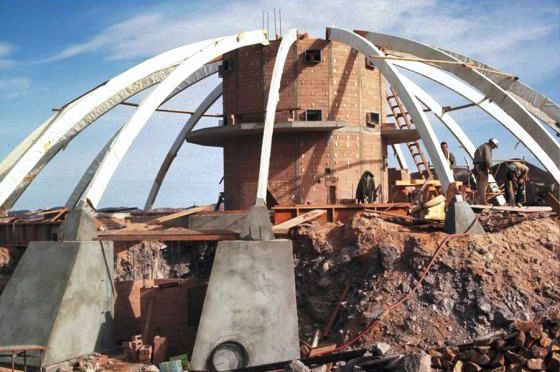
The Volcano House outside of Barstow is built on a cinder cone, a volcanic bubble of sorts. It follows the form of the cone with a white domed roof, and from a distance it looks like a snow-capped peak from outer space.

More photos

“We like to joke with our friends that have never seen it before, that we're not sure when it landed,” said nearest neighbor Spike Lynch, who lives a mile away.

Following the space-time continuum, but backward, a step inside is to experience the swinging '60s, a decade many of us joke that if we remember it, we weren't there.

The circular home with 360 degrees of sliding glass panels is surprisingly spacious for a house in the round – two bedrooms, two baths, living and dining rooms and a conversation pit. George Jetson would have been proud.

All the rooms are divided by floating interior walls that share the same domed ceiling. The top of the dome is an observation deck.

The house was built in 1968 by Vard Wallace, a Newport Beach resident who invented a drafting machine widely used in the aircraft industry during World War II.

There are 1,800 square feet of living space, 60 acres of desert, a small caretaker house and a man-made lake that could use a little landscaping. The view in some directions is the distant horizon, and it is so quiet you could hear a pin drop but for the lone coyote howling at dusk.

“Serenity is what attracts people to desert,” said Lynch. “There's nothing like watching the stars come out here.”

The domed roof also shelters a 5-foot-wide moat that was intended as a swimming pool, but proved too dirty after the first few sandstorms.

Howser bought the house on the spot from its third owner, midcentury fan and British developer Richard Bailey, in 2003.

Caretaker Ray Laporte said Howser signed on the dotted line within minutes of seeing the place. An impulse buy, but he rarely used it.

“It's pretty difficult getting up and down the narrow road,” said Lynch. “In fact, when they were pouring the dome, they couldn't find a concrete contractor to go up. It was so steep the concrete would pour out of the back of the truck.”

The problem was solved by a man from Barstow who backed all the way up the 10-foot wide road to deliver the concrete. Lynch recalls that portion of the job took months to complete.

Howser had it on the market in 2009, but ended up giving the house to Chapman University over lunch at the Filling Station in Old Towne Orange with Chapman's president, Jim Doti.

Register reporter Sherri Cruz wrote that in April of that year, while they sat on the patio, Doti asked about the house and Howser said something like: “Oh yeah, I bought that 10 years ago. I hardly ever used it, but I fell in love with the place. Why? Do you want it?”

The university plans to use the house for desert studies, astronomy and geology pursuits.

When flares fire into the sky over the nearby Twentynine Palms Marine Air Ground Combat Center, the large white lights hang with the stars for minutes. Lynch likes to tell his guests that the aliens are coming back for it.

Friday, April 5, 2013

Volcano House

Volcano House (Katie Kland)
By Sherri Cruz
Orange County Register


Chapman University has repurposed numerous historic buildings, but a spaceship-style home perched 150 feet atop a volcanic cone?

"We've never quite encountered a house like this," said Kris Olsen, vice president of campus planning and operations for Chapman University.

"The architectural design feels like Austin Powers meets George Jetson," Olsen said.

See more Volcano House images

The home, known as the Volcano House, was a gift to Chapman from the late Huell Howser, who hosted and produced the "California's Gold" travel series on PBS.

Chapman's plans for the Volcano House include poetry gatherings for faculty and students, artist retreats, and astronomy and biology studies.

The house is set on 60 acres in the Mojave Desert, where silence and starry nights reign. It has a 360-degree glass perimeter – 24 glass doors that can be opened to the desert breeze when the weather is suitable.
Inside, a circular stairway leads to a stargazing deck on the roof.

Making the property even more spectacular is a spring-fed lake at the foot of the volcanic mountain.
Olsen has been directing the restoration of the property, which started in earnest last spring and recently concluded.

The home's bones were good, but the property had some deferred maintenance and needed some minor interior fixes.

"We drained the lake and put a new clay bottom in it," Olsen said.

Chapman refurbished the electrical, sewer, heating, ventilation and cooling systems.

Aday Architects in Glendora was tapped to spruce up the interior, while keeping the midcentury architecture intact.

Even the shag rug in the sunken living room was replaced with a new one.

"We found a carpet mill that produces shag and replaced it with similar shag," Olsen said.

"It's in good function for accommodating people now," Olsen said.

In the future, Chapman plans to add dormitories at the base of the volcanic mountain to accommodate large groups for overnight stays.

Howser's gifts to Chapman stemmed from a friendship that was struck between Howser and Chapman's President Jim Doti.

It began with a note Doti wrote to Howser.

After Doti watched a "California's Gold" segment on Old Towne Orange, he invited Howser to the campus. "When I saw it, I was disappointed that he didn't come visit the Chapman campus," Doti said.

Howser took Doti up on the invitation and visited the campus a few months later.

It was love at first sight. "He just fell in love with Chapman, the spirit of the place and the people," Doti said.

Doti was one of a handful of people who knew that Howser was terminally ill.

Howser kept his illness private.

What many people didn't know – not even Doti – was that Howser was the owner of the Volcano House. That mystery was revealed when Howser put the home on the market a few years back for $750,000.

People who knew Howser knew him as a longtime resident of the El Royale Apartments in Los Angeles.

Howser also owned a couple of other homes, but rarely used the Volcano House. He bought the Volcano House on a whim, Doti said.

"I think he bought more of a work of art than a home," Doti said. "He was really into aesthetic kinds of things," he said. "His homes were literally art museums."

Doti found out about Howser's uncommon dwelling during lunch with Howser at the Filling Station Cafe in Old Towne, a couple of blocks from campus.

By that time, Howser had already been working diligently with Armando Diaz in Chapman's media services to digitize and archive his TV segments.

"Huell was a stickler about quality, perfection, having it done right," Doti said.

While they sat on the Filling Station's patio, Doti asked about reports that Howser was the owner of the Volcano House.

According to Doti, Howser said something like: "Oh yeah, I bought that 10 years ago. I hardly ever used it, but I fell in love with the place. Why? Do you want it?"

Doti didn't know if he wanted it. He asked about it only because he was intrigued by the house itself.
But Howser was serious, Doti said.

Howser thought it would be wonderfully serendipitous if the house he bought on a whim could be used for educational purposes.

"He said it would be a culmination of something that was meant to be," Doti said.

With Howser's offer, Doti checked in with Chapman's chancellor, Daniele Struppa. Struppa sent a memo to all the deans at Chapman, asking if they could use the property.

"Without exception, all of the deans said 'Yes,'" Doti said.

Doti called Howser and told him the ideas. "He was pleased. It was his dream."

Howser took the home off the market. Then he took Doti and Olsen on a grand adventure to visit it.

They all met at Peggy Sue's 50's Diner (where there's a sandwich named after Howser) near Calico Ghost Town. From there, they drove 20 minutes along a gravel road. "All of a sudden you see – standing alone – this volcano-shaped mountain," Doti said.

"As you get closer, you see the structure on top of it. It looks literally like a flying saucer landed on the top," he said.

"It's surreal," Doti said. "It's truly surreal."

In addition to the Volcano House, Howser gave Chapman nearly 1,000 TV segments, his book library, the proceeds of the sales from his two other desert homes (now designated for scholarships) and his "found art" collection that adorned his homes.

Tuesday, February 19, 2013

Volcano house now home to higher learning

Huell Howser gifted his 'volcano house' to Chapman University last year.
Chapman University hopes to have landmark functional by summer

SHEA JOHNSON, STAFF WRITER
Desert Dispatch


NEWBERRY SPRINGS • It was described 10 years ago as a “launch pad for desert living” by the Los Angeles Times. Replace “living” with “learning” and it would describe the latest intent for the domed dwelling perched atop a cinder cone in Newberry Springs.

In one of several gifts to Chapman University, Huell Howser, the amicable host of the long-running PBS series “California’s Gold,” donated the so-called volcano house to the school last year.

As of now, it’s slated to be a home base for study tours in environmental science and astronomy, television and film projects, writer’s retreats and other activities, said Mary Platt, the director of communications and media relations for the university.

“The possibilities are endless,” Platt said, adding that the house is an “iconic piece of architecture.”

The university’s campus planning department is currently providing general maintenance to the property, which was on the market for $750,000 only two and half short years ago.

So, why the donation from the late Howser?

“He had forged this extraordinary friendship with the university,” Platt said. “He came down many times during the last years of his life.”

That friendship was ignited after an episode of “California’s Gold” aired featuring Orange Circle, a historic downtown plaza only blocks from the campus. Jim Doti, president of Chapman University, wrote Howser a note that suggested Howser should have visited the campus as well, Platt explained.

Howser would take Doti up on his offer and become enamored with the university.

Aside from the “volcano house” donation, Howser gifted Chapman with his art collection. Also, earnings from the sale of his Twentynine Palms residence will go toward the university’s California’s Gold scholarship.

In return, Chapman University has digitized episodes of “California’s Gold” — a mutual agreement to make the show available to the world for free — and is in the process of cataloging each episode by subject.

“He was extraordinarily generous to Chapman University,” Platt said. “He wanted us to be the keepers of his legacy.”

Howser never had children of his own, Platt noted, but “he thought of our students as his children.”

Visit www.huellhowserarchive.com to view the Huell Howser California’s Gold Archive.

Monday, January 7, 2013

California TV Personality Huell Howser Dead at Age 67

The Tennessee native with an interview style described as "magnificently unslick" moved to Los Angeles in 1981
Huell Howser
By Jonathan Lloyd
KNBC-TV


California television personality Huell Howser, known for his affable interview style as he toured some of the state's landmark locations, died Sunday night at age 67, according to KCET.

Howser, the host of TV's "California's Gold", retired from the show at the end of November after nearly two decades on public television stations. Howser died Sunday night from "natural causes," according to KCET.

Ryan Morris, Howser's producer and long-time friend, confirmed he died Sunday night at home after a "long illness."

Howser moved to Los Angeles in 1981. The Tennessee native worked at a television station in Nashville before serving in the Marine Corps.

He worked at WCBS in New York before moving to LA. "California's Gold" became the best known of Howser's magazine-style TV shows about his travels in the state, but he also hosted "Visiting with Huell Howser," "Road Trip with Huell Howser" and other programs.

Howser, who lived in Twenty-Nine Palms and Los Angeles, was known for his friendly style during his behind-the-scene interviews at restaurants, historic sites, schools and other community institutions.

His style was described as "magnificently unslick" by LA Times columnist Howard Rosenberg.

Map: Huell Howser's California

"We operate on the premise that TV isn’t brain surgery. People’s stories are what it’s all about," Howser said in a post on CalGold.com, the website of Huell Howser Productions. "If you have a good story, it doesn’t have to be overproduced. I want our stories to reveal the wonders of the human spirit and the richness of life in California, including its history, people, culture and natural wonders."

Howser's programs were broadcast on KCET in Southern California. A statement on the station's website described Howser as a host who "elevated the simple joys and undiscovered nuggets of living in our great state. He made the magnificence and power of nature seem accessible by bringing it into our living rooms. Most importantly, he reminded us to find the magic and wonderment in our lives every day."

In September 2011, Howser announced that he planned to donate his "California's Gold" episodes to Chapman University in Orange. The donation includes show episodes, papers and memorabilia related to the show.

The items are part of the Huell Howser Archive. Howser selected Chapman University because the school's president, James Doti, sent him a note to apologize after failing to connect with Howser during his visit to Orange.

"That really impressed me -- in this hectic world, to get a personal letter signed by the university president," Howser said of the letter. "That’s the kind of personal contact that resonates with me. It got me thinking about the legacy of my work and how I wanted it to become available to a wider audience."