The Mojave Desert Archives is housed in the Dennis G. Casebier Library, a state-of-the-art archival repository built in the image of the historic Goffs Santa Fe Railway Depot (1902-1956). This 6,000 square-foot building was made possible by a grant from the California Cultural and Historical Endowment and the membership of the Mojave Desert Heritage and Cultural Association (MDHCA).
The entrance to the Library is through the green door, just to the right of the old baggage cart and platform (below) in the two-story part of the building.
Upon entering the Library Reading Room, visiting researchers are greeted by staff and provided with an orientation on Archives rules and procedures. The large library table (below) is is where the researcher will set up, receive requested materials, and conduct their study. (Click on image to see full-size)
This wide view of the Reading Room (below) shows the location of the staff station on the right side of the room. The microfilm reader station is located in between the library table (center) and the staff station. Bookcases containing oral history transcripts and reference books line the walls.
Between the microfilm reader and staff stations is the Archives Citation bookcase. There are more than 130 titles assembled on the shelves in which the Mojave Desert Archives are referenced. The types of publications making up this collection are scholarly theses, historical monographs, government reports, and the in-house publications of the MDHCA. This output is the most visible representation of how the Mojave Desert Archives gives back to our community.
Inside the low and long one-story portion of the Library building, called the Freight House, is where the stacks of the repository are stored. The Freight House is divided into two equally sized rooms. Below is the north room. The file cabinets contain our Subject Files, processed manuscript collections, microfilm, pamphlets, and periodicals, such as a full set of Desert Magazine.
The north room has a scanning station for photographic and microform materials (below). This equipment is typically used to fulfill reference requests for long-distance researchers.
The north Freight House also houses the server rack for the Archives (below). This system runs ArchivesSpace, a web-based archives information management system, used to organize the collections of the Mojave Desert Archives and to develop collection guides for upload to the Online Archive of California. The digital assets of the collections are also preserved and backed up here. [Systems gifted by Smile Brands, Inc., Irvine, California.]
The north Freight House is also home to a small exhibit of framed photographic enlargements from the O. A. Russell Photograph Collection and vintage World War I and II war bond posters.
Interpretive graphic for the O. A. Russell photo exhibit (below).
The south Freight House contains both processed and unprocessed collections. The record storage racks (below) contain accessioned materials that are awaiting arrangement and description. The major collections stored here are those of desert writers Harold and Lucile Weight, San Bernardino County researcher Germaine Moon, and desert land activist Hildamae Voght.
The long tables in the lower right portion of the image below provide an excellent work space for handling oversized materials or for beginning the process of organizing materials from the record storage boxes.
The south Freight House is also home to flat files containing the 7,000 historical maps of the Mojave Desert Archives.
We hope you have enjoyed this virtual tour of the Mojave Desert Archives. In-person tours are typically led by the Archivist at the annual Mojave Road Rendezvous, held at the Goffs Cultural Center in early fall. Thank you!
Showing posts with label archives. Show all posts
Thursday, February 2, 2017
Thursday, June 23, 2016
Tuesday with Fran Elgin, former Victor Valley College librarian and archivist
![]() |
| Cover of Fran Elgin's book on the history of Rancho Yucca Loma, a desert getaway for celebrities in the 1930s through the 1950s. |
Victorville Daily Press
Meet Fran Elgin.
She’s a longtime Mohahve Historical Society member, an author and a retired Victor Valley College librarian, where she worked for more than 24 years.
But nowadays Fran spends her time in the past.
I received a letter from her on Monday in which she addressed me as “Mr. Cabe” — completely unnecessary — before detailing a little about herself, including the volunteer work she does keeping up the vast collection in VVC’s Local History Room.
So on Tuesday — her volunteer day — I took a trip over to my community-college alma mater to hear Fran’s take on the archiving of our history.
“The historical society, in the early ’80s, they had been keeping things in garages, including photographs and so on,” she said. “I started going to their meetings, and they asked me to be on the board. After a while they asked if they could bring this stuff to the college library. And the president and vice president at the time said that would be OK.”
This was in the old library, mind you, where the Math Success Center is today.
“And they brought these rickety old file cabinets,” she said. “Nothing was organized ... The historical society doesn’t have a home. We meet at the museum. In the ’70s, the museum and the historical society were like this, but then something happened. I don’t know exactly what ... So, anyway, over the years we’ve built this up.”
It’s an astounding collection.
In addition to hundreds of books, the Local History Room houses videos, audio-cassette recordings that document the oral histories of prominent High Desert figures, all of the original “Desert Magazine” issues that were published from 1937 to 1985, not all but a thick binder full of Stuart Kellogg’s “A Dry Heat” columns, and nearly 2,400 historical photographs that are catalogued in a database.
What sort of photographs makes it into the collection?
“Almost anything that has to do with the history (of the Victor Valley and the Mojave Desert),” Fran said. “Some of them aren’t very good. Some of them are very poor quality. But anything with historical value, and sometimes you’d be surprised what people are looking for.”
I asked Fran if she’d seen the black-and-white photograph Ansel Adams took of a massive Joshua Tree near Victorville in 1947. She hadn’t, but we both agreed it would make a fine inclusion before moving on.
“We have all the Apple Valley News (back issues),” she said, pointing to stacks upon stacks of bound newspapers situated atop two or three filing cabinets. “After Eva Conrad died, her son brought all these over because I had interviewed her a few years before. They’re getting pretty fragile.”
Eva Conrad was the editor of the Apple Valley News from 1950 to 1983. She also owned and operated the paper with her husband, Lloyd, a former Los Angeles Times reporter. Described as “fiery and outspoken” in her Daily Press obituary, Mrs. Conrad wrote a weekly column called “Speak No Eva,” excerpts of which were often reprinted in Reader’s Digest and the Atlantic Monthly.
Before we moved on, I took a minute to appreciate the motto that Eva and Lloyd Conrad ran across the Apple Valley News’ masthead: “A Very Independent Newspaper.”
Much of what has been amassed and incorporated into the Local History Room’s collection over the years — only a fraction of which I’ve discussed here — is well-documented and neatly catalogued, though Fran thinks it could be better.
“Well, how many volunteers do you get normally?” I asked.
“Me,” she said. “I’ve had a couple over the years, but they didn’t work out for this reason or that. Like the last person, she was great, but she got a detached retina and hasn’t been able to drive. But there have been a few.”
It baffled me to learn that Fran had taken it upon herself to — almost single-handedly — piece together the history of this desert and its inhabitants.
Fran doesn’t seem to mind though. Being as sweet as she is, I can’t imagine she holds a grudge against people for being too busy living their lives to offer a little help.
I only wish they knew that when those lives end, Fran just might be the one to come along and gather up what remains.
Wednesday, December 16, 2015
On the Road: Museum hosts program on history of Mojave Road
MOJAVE ROAD: Speaking at the Colorado River Historical Society Museum earlier this week, eastern Mojave Desert historian Dennis Casebier gave a presentation covering the history of the Mojave Road, from its beginnings as a trail used by native tribes, to its present-day status as a recreational trail. “We’re extremely proud to have Dennis here,” said Karole Finkelstein, CRMHSM vice president. “There is no one more qualified to talk about the Mojave Road and the history of the eastern Mojave Desert.” - DK McDONALD/The Daily News
By DK McDONALD
The Daily News
BULLHEAD CITY — G.K. Chesterton called history a road to be reconsidered and even retraced.
For Mojave Desert historian Dennis Casebier, the history of one road has been his focus for more than 60 years.
Speaking to a standing-room-only crowd at the Colorado River Historical Society Museum on Monday, Casebier covered the history of the road, from its beginnings as a trail used by native tribes, through time to its importance in moving troops for training during World War II, to its present-day status as a recreational trail, generously illustrated throughout with historic and personal photos, anecdotes, and stories of his drive to preserve history through the cultural center.
“It was an excellent presentation,” said Nancy Nelson, who attended with her husband, Barry. “We traveled the Mojave Road without knowing much of its history, so this is kind of after-the-fact. Just about everything he told us we didn’t know. The history is fascinating.”
Casebier and other proponents of preserving the route founded the Friends of the Mojave Road in 1981; working with the Bureau of Land Management, Casebier and the group identified the route of the trail.
The Mojave Road is unique in that for most of its 138-mile length it is in much the same condition as it was when formed more than 150 years ago, he said. Bisecting the Mojave National Preserve, the twin tracks functioned primarily as a supply, rather than migration, route, and the road was overlooked while many other early major Western routes were upgraded into state and national highways.
The Friends insisted that the BLM place no signage to mark the route; in order to help preserve the road from overuse and prevent the unprepared from attempting its crossing, navigation is only possibly by locating strategically placed rock cairns and through the travel guide.
“It’s a four-wheel-drive-only road,” Casebier said. “In order to travel the road you have to buy the Mojave Road Guide, which tells you how to access the road, and how to behave while on it. It is a dangerous place; people have died out there.”
The road guide is available at the Colorado River Historical Society Museum, 2201 Highway 68.
“It was a wonderful presentation,” said attendee Leroy Jackson. “I am so interested in his stories of earlier pioneers homesteading the region. It’s amazing to think you could be standing in the same places those people walked.”
Casebier, a retired U.S. Navy physicist, is the driving force behind the most complete archive of Mojave Desert history in existence — the Mojave Desert Heritage and Cultural Association in Goffs, Calif.
“He’s a historian above all historians, as far as I’m concerned,” said Elsie Needles, Colorado River Historical Society and Museum president. “He’s devoted his life to that area, and no one is better than Dennis at finding Mojave Desert history.”
Casebier began gathering archival materials pertaining to the Mojave Desert in 1954. When the Friends group transitioned to registered nonprofit status in 1993, his personal collection became the seed of the most complete library known on the history of the eastern Mojave Desert; the cultural center now houses more than 108,000 photographs, 6,000 historic maps of the region, 3,000 files on individuals and cultural sites of interest, 1,300 oral history files, and 6,000 volumes of published literature, including the library and personal papers of desert bibliographer E. I. Edwards, the library and collection of Harold and Lucile Weight, and the collection of San Bernardino County historian Germaine L. Moon.
By DK McDONALD
The Daily News
BULLHEAD CITY — G.K. Chesterton called history a road to be reconsidered and even retraced.
For Mojave Desert historian Dennis Casebier, the history of one road has been his focus for more than 60 years.
Speaking to a standing-room-only crowd at the Colorado River Historical Society Museum on Monday, Casebier covered the history of the road, from its beginnings as a trail used by native tribes, through time to its importance in moving troops for training during World War II, to its present-day status as a recreational trail, generously illustrated throughout with historic and personal photos, anecdotes, and stories of his drive to preserve history through the cultural center.
“It was an excellent presentation,” said Nancy Nelson, who attended with her husband, Barry. “We traveled the Mojave Road without knowing much of its history, so this is kind of after-the-fact. Just about everything he told us we didn’t know. The history is fascinating.”
Casebier and other proponents of preserving the route founded the Friends of the Mojave Road in 1981; working with the Bureau of Land Management, Casebier and the group identified the route of the trail.
The Mojave Road is unique in that for most of its 138-mile length it is in much the same condition as it was when formed more than 150 years ago, he said. Bisecting the Mojave National Preserve, the twin tracks functioned primarily as a supply, rather than migration, route, and the road was overlooked while many other early major Western routes were upgraded into state and national highways.
The Friends insisted that the BLM place no signage to mark the route; in order to help preserve the road from overuse and prevent the unprepared from attempting its crossing, navigation is only possibly by locating strategically placed rock cairns and through the travel guide.
“It’s a four-wheel-drive-only road,” Casebier said. “In order to travel the road you have to buy the Mojave Road Guide, which tells you how to access the road, and how to behave while on it. It is a dangerous place; people have died out there.”
The road guide is available at the Colorado River Historical Society Museum, 2201 Highway 68.
“It was a wonderful presentation,” said attendee Leroy Jackson. “I am so interested in his stories of earlier pioneers homesteading the region. It’s amazing to think you could be standing in the same places those people walked.”
Casebier, a retired U.S. Navy physicist, is the driving force behind the most complete archive of Mojave Desert history in existence — the Mojave Desert Heritage and Cultural Association in Goffs, Calif.
“He’s a historian above all historians, as far as I’m concerned,” said Elsie Needles, Colorado River Historical Society and Museum president. “He’s devoted his life to that area, and no one is better than Dennis at finding Mojave Desert history.”
Casebier began gathering archival materials pertaining to the Mojave Desert in 1954. When the Friends group transitioned to registered nonprofit status in 1993, his personal collection became the seed of the most complete library known on the history of the eastern Mojave Desert; the cultural center now houses more than 108,000 photographs, 6,000 historic maps of the region, 3,000 files on individuals and cultural sites of interest, 1,300 oral history files, and 6,000 volumes of published literature, including the library and personal papers of desert bibliographer E. I. Edwards, the library and collection of Harold and Lucile Weight, and the collection of San Bernardino County historian Germaine L. Moon.
Sunday, November 3, 2013
Archivist revels in state's treasures and mysteries
Jeff Kintop displays a U.S. flag, hand painted on Oct. 31, 1864 to commemorate Nevada's statehood, stored in 'The Vault' at the Nevada State Library and Archives in Carson City. The flag, which flew over Fort Ruby, is believed to be the first 36-star flag. (Reno Gazette-Journal)
Written by Guy Clifton
Reno Gazette-Journal
A funny thing happened to Jeff Kintop on his career path back to his native Minnesota.
He fell in love with Nevada, and the rest, quite literally, is history.
Kintop, the Nevada state archivist, moved to Reno in 1979 to work on a grant-funded history education project at the University of Nevada, Reno.
“After four years of working at UNR, the grant ended and I had to go look for other work,” said Kintop, 62, who took over the top job at the Nevada State Library and Archives in 2009 after longtime archivist Guy Rocha retired. “I had come from Minnesota (he earned a master’s in history from Mankato State), and I always thought I would end up back at Minnesota, where they have a very large historical society. We already had two kids then, and my wife said, ‘You can find another job,’ and she meant here (in Nevada).”
There was one problem in 1983. The country was in a recession and full-time jobs were hard to come by.
That’s when Kintop received a call from Rocha.
“Guy called and said, ‘I have this part-time opening that doesn’t pay hardly anything, but it’s a job,’” Kintop said. “I took it.”
He worked part time at the Nevada State Archives in Carson City and also took a part-time job as a scholar in residence for Sierra County, Calif., working with the schools in Downieville, Portola and other towns in the county.
Two years later, in 1985, the recession was coming to an end and the job at the state archives was expanded to full time. Kintop became the curator of archives and manuscripts.
“It’s been pretty exciting pretty much ever since,” Kintop said.
One of Kintop’s roles as the archives manager was to be the caretaker of some of the state’s most-prized documents — one-of-a-kind items that tell the state’s history and which are not replaceable. Most of them are kept in a special area known as “the vault.”
The vault is temperature-controlled, humidity-controlled and is protected by halon gas in case of a fire.
The oldest item in the vault is the “First Records of Carson Valley, Utah Territory.
“When John Reese and the first settlers decided they were going to stay the winter, they formed their own government and petitioned Congress to form a territorial government,” Kintop said, explaining the fledgling government kept its records in the small book dated Nov. 12, 1851.
This record book was stolen in 1989 when the State Archives moved to its present location on Stewart Street in Carson City. A worker helping with the move stole the book and sold it to a collector for $800.
It was eventually recovered and returned to the state.
The vault also includes the first U.S. 36-star flag (commemorating Nevada’s admission to the Union as the 36th state). On Oct. 31, 1864, a group of enterprising soldiers at Fort Ruby in Elko County decided to commemorate the occasion.
The soldiers hand-painted their own flag to fly above the fort in the shadow of the Ruby Mountains of eastern Nevada. The fort’s surgeon, upon leaving Fort Ruby years later, took the flag with him to Ohio, where it remained in his family for decades.
When Nevada celebrated its centennial in 1964, the surgeon’s grandson presented it to Gov. Grant Sawyer and it has been in the state’s possession ever since.
Seeing and touching the state’s history — and uncovering it to share with others — has been Kintop’s passion for more than 30 years.
He and Rocha co-authored a book about Wyatt Earp and his family’s Nevada connections titled “The Earps’ Last Frontier.”
Kintop said knowing the names of the people who built Nevada is one thing, but knowing about the people themselves, beyond the names, has been fascinating. In researching a water rights lawsuit from the 1880s, he learned the personal stories and put names to faces of old photographs from some of Nevada’s first citizens.
The best part, Kintop said, is that there are more treasures to be found and more history to be written and shared with Nevadans about their home state.
“There are still mysteries out there,” he said with a smile.
With Nevada celebrating its sesquicentennial over the next 12 months, his office is abuzz with activity — everything from people asking permission to use the copyrighted state song, “Home Means Nevada,” to people needing research on one historical tidbit or another.
Kintop lives in Reno with his wife, Dale. They have two daughters, Krista Phillips and Caitlin Fletcher, two grandchildren and two more on the way.
His thoughts of returning to Minnesota are, literally, history.
“I haven’t thought about it for years,” he said. “Nevada is home. It’s been home for 34 years now. I’ve spent more time here than anywhere else in my life. I love it here.”
Written by Guy Clifton
Reno Gazette-Journal
A funny thing happened to Jeff Kintop on his career path back to his native Minnesota.
He fell in love with Nevada, and the rest, quite literally, is history.
Kintop, the Nevada state archivist, moved to Reno in 1979 to work on a grant-funded history education project at the University of Nevada, Reno.
“After four years of working at UNR, the grant ended and I had to go look for other work,” said Kintop, 62, who took over the top job at the Nevada State Library and Archives in 2009 after longtime archivist Guy Rocha retired. “I had come from Minnesota (he earned a master’s in history from Mankato State), and I always thought I would end up back at Minnesota, where they have a very large historical society. We already had two kids then, and my wife said, ‘You can find another job,’ and she meant here (in Nevada).”
There was one problem in 1983. The country was in a recession and full-time jobs were hard to come by.
That’s when Kintop received a call from Rocha.
“Guy called and said, ‘I have this part-time opening that doesn’t pay hardly anything, but it’s a job,’” Kintop said. “I took it.”
He worked part time at the Nevada State Archives in Carson City and also took a part-time job as a scholar in residence for Sierra County, Calif., working with the schools in Downieville, Portola and other towns in the county.
Two years later, in 1985, the recession was coming to an end and the job at the state archives was expanded to full time. Kintop became the curator of archives and manuscripts.
“It’s been pretty exciting pretty much ever since,” Kintop said.
One of Kintop’s roles as the archives manager was to be the caretaker of some of the state’s most-prized documents — one-of-a-kind items that tell the state’s history and which are not replaceable. Most of them are kept in a special area known as “the vault.”
The vault is temperature-controlled, humidity-controlled and is protected by halon gas in case of a fire.
The oldest item in the vault is the “First Records of Carson Valley, Utah Territory.
“When John Reese and the first settlers decided they were going to stay the winter, they formed their own government and petitioned Congress to form a territorial government,” Kintop said, explaining the fledgling government kept its records in the small book dated Nov. 12, 1851.
This record book was stolen in 1989 when the State Archives moved to its present location on Stewart Street in Carson City. A worker helping with the move stole the book and sold it to a collector for $800.
It was eventually recovered and returned to the state.
The vault also includes the first U.S. 36-star flag (commemorating Nevada’s admission to the Union as the 36th state). On Oct. 31, 1864, a group of enterprising soldiers at Fort Ruby in Elko County decided to commemorate the occasion.
The soldiers hand-painted their own flag to fly above the fort in the shadow of the Ruby Mountains of eastern Nevada. The fort’s surgeon, upon leaving Fort Ruby years later, took the flag with him to Ohio, where it remained in his family for decades.
When Nevada celebrated its centennial in 1964, the surgeon’s grandson presented it to Gov. Grant Sawyer and it has been in the state’s possession ever since.
Seeing and touching the state’s history — and uncovering it to share with others — has been Kintop’s passion for more than 30 years.
He and Rocha co-authored a book about Wyatt Earp and his family’s Nevada connections titled “The Earps’ Last Frontier.”
Kintop said knowing the names of the people who built Nevada is one thing, but knowing about the people themselves, beyond the names, has been fascinating. In researching a water rights lawsuit from the 1880s, he learned the personal stories and put names to faces of old photographs from some of Nevada’s first citizens.
The best part, Kintop said, is that there are more treasures to be found and more history to be written and shared with Nevadans about their home state.
“There are still mysteries out there,” he said with a smile.
With Nevada celebrating its sesquicentennial over the next 12 months, his office is abuzz with activity — everything from people asking permission to use the copyrighted state song, “Home Means Nevada,” to people needing research on one historical tidbit or another.
Kintop lives in Reno with his wife, Dale. They have two daughters, Krista Phillips and Caitlin Fletcher, two grandchildren and two more on the way.
His thoughts of returning to Minnesota are, literally, history.
“I haven’t thought about it for years,” he said. “Nevada is home. It’s been home for 34 years now. I’ve spent more time here than anywhere else in my life. I love it here.”
Labels:
archives,
archivist,
cultural resources,
Nevada
Location:
Reno, NV, USA
Monday, September 23, 2013
The people behind Pioneer’s Museum preserving the Imperial Valley’s history
Tractor at Desert Museum: A rare tractor sits in storage at the museum. It is one of a few left in the world and is in working condition. (Erick Miller, Staff Photographer)
By ALEXIS RANGEL, Staff Writer
Imperial Valley Press
IMPERIAL — Lynn Housouer had heard stories as a young girl about her great-great-grandfathers both fighting against each other in the American Civil War but she never really paid attention until she was old enough to do her own research.
As the Chief Executive Officer and Archivist at Imperial County’s Pioneer Museum, she said oftentimes when we are young we don’t always pay attention to the stories our elders share with us.
“So you just hear it,” Housouer said, “until you are old enough to do your own research because now that my grandmother is gone I can’t call and ask her (questions) like I should have asked her when she was telling me the stories.”
Which is unfortunate, but makes Housouer’s work in preserving the Imperial Valley’s history for future generations all the more important.
She speaks from personal experience, as she says that after her grandparents passed she began cleaning out her grandmother’s sewing room.
To her surprise she discovered a box high above a shelf.
Climbing to reach the box she found an old picture of her great grandfather during the Spanish-American War with his uniform below the photo.
Having worked on the archives for the past 20 years Housouer has handled hundreds if not thousands of artifacts with the help of the museum’s curator Leanne Rutherford.
Both Housouer and Rutherford agree that they have always had an interest in history and working at the museum feels like a treasure hunt.
With more than 6,000 artifacts at the museum everything you see on display is tied in to the history of the Imperial Valley.
Housouer’s role at the museum as the archivist is preservation, she says.
Preserving artifacts, cataloging them into the computer, and making sure they are in an acid-free file folder or bag is an instrumental part of an being an archivist.
“We do what we can to preserve them for our future generations,” she said.
The museum runs on the help of volunteers, willing to give their time in preserving the county’s history.
One of those volunteers, Rutherford helps Housouer research the thousands of artifacts that go into their database.
Rutherford sees her position as the curator a bit different than one might at other museums.
“I help raise funds to keep the museum doors open,” Rutherford said.
Along with fundraising, Rutherford said her strength is in helping Housouer research the artifacts they receive.
Rutherford said she can spend weeks researching an item.
“Because you get to a point and you can’t find the answer you were looking for,” she said, “and you need to know what is going on.”
As curator and archivist at the museum it can be tedious work but Rutherford and Housouer say it is a passion of theirs.
By ALEXIS RANGEL, Staff Writer
Imperial Valley Press
IMPERIAL — Lynn Housouer had heard stories as a young girl about her great-great-grandfathers both fighting against each other in the American Civil War but she never really paid attention until she was old enough to do her own research.
As the Chief Executive Officer and Archivist at Imperial County’s Pioneer Museum, she said oftentimes when we are young we don’t always pay attention to the stories our elders share with us.
“So you just hear it,” Housouer said, “until you are old enough to do your own research because now that my grandmother is gone I can’t call and ask her (questions) like I should have asked her when she was telling me the stories.”
Which is unfortunate, but makes Housouer’s work in preserving the Imperial Valley’s history for future generations all the more important.
She speaks from personal experience, as she says that after her grandparents passed she began cleaning out her grandmother’s sewing room.
To her surprise she discovered a box high above a shelf.
Climbing to reach the box she found an old picture of her great grandfather during the Spanish-American War with his uniform below the photo.
Having worked on the archives for the past 20 years Housouer has handled hundreds if not thousands of artifacts with the help of the museum’s curator Leanne Rutherford.
Both Housouer and Rutherford agree that they have always had an interest in history and working at the museum feels like a treasure hunt.
With more than 6,000 artifacts at the museum everything you see on display is tied in to the history of the Imperial Valley.
Housouer’s role at the museum as the archivist is preservation, she says.
Preserving artifacts, cataloging them into the computer, and making sure they are in an acid-free file folder or bag is an instrumental part of an being an archivist.
“We do what we can to preserve them for our future generations,” she said.
The museum runs on the help of volunteers, willing to give their time in preserving the county’s history.
One of those volunteers, Rutherford helps Housouer research the thousands of artifacts that go into their database.
Rutherford sees her position as the curator a bit different than one might at other museums.
“I help raise funds to keep the museum doors open,” Rutherford said.
Along with fundraising, Rutherford said her strength is in helping Housouer research the artifacts they receive.
Rutherford said she can spend weeks researching an item.
“Because you get to a point and you can’t find the answer you were looking for,” she said, “and you need to know what is going on.”
As curator and archivist at the museum it can be tedious work but Rutherford and Housouer say it is a passion of theirs.
Tuesday, February 19, 2013
Volcano house now home to higher learning
![]() |
| Huell Howser gifted his 'volcano house' to Chapman University last year. |
SHEA JOHNSON, STAFF WRITER
Desert Dispatch
NEWBERRY SPRINGS • It was described 10 years ago as a “launch pad for desert living” by the Los Angeles Times. Replace “living” with “learning” and it would describe the latest intent for the domed dwelling perched atop a cinder cone in Newberry Springs.
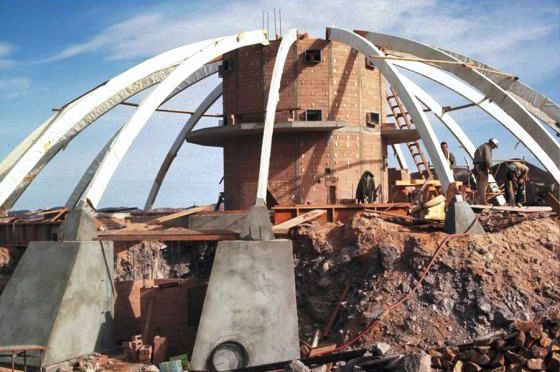
In one of several gifts to Chapman University, Huell Howser, the amicable host of the long-running PBS series “California’s Gold,” donated the so-called volcano house to the school last year.
As of now, it’s slated to be a home base for study tours in environmental science and astronomy, television and film projects, writer’s retreats and other activities, said Mary Platt, the director of communications and media relations for the university.
“The possibilities are endless,” Platt said, adding that the house is an “iconic piece of architecture.”
The university’s campus planning department is currently providing general maintenance to the property, which was on the market for $750,000 only two and half short years ago.
So, why the donation from the late Howser?
“He had forged this extraordinary friendship with the university,” Platt said. “He came down many times during the last years of his life.”
That friendship was ignited after an episode of “California’s Gold” aired featuring Orange Circle, a historic downtown plaza only blocks from the campus. Jim Doti, president of Chapman University, wrote Howser a note that suggested Howser should have visited the campus as well, Platt explained.
Howser would take Doti up on his offer and become enamored with the university.
Aside from the “volcano house” donation, Howser gifted Chapman with his art collection. Also, earnings from the sale of his Twentynine Palms residence will go toward the university’s California’s Gold scholarship.
In return, Chapman University has digitized episodes of “California’s Gold” — a mutual agreement to make the show available to the world for free — and is in the process of cataloging each episode by subject.
“He was extraordinarily generous to Chapman University,” Platt said. “He wanted us to be the keepers of his legacy.”
Howser never had children of his own, Platt noted, but “he thought of our students as his children.”
Visit www.huellhowserarchive.com to view the Huell Howser California’s Gold Archive.
Tuesday, July 1, 2008
An Endowment to Keep the Goffs Cultural Center Operating in Perpetuity
FUND-RAISING
by Dennis G. Casebier
Over the past couple of years we’ve been soliciting funds from you, our membership, to furnish and equip the new Library/Depot. Through your support and generosity we reached our goal of $250,000 some time ago. Thank you!
The grant we received for construction of the beautiful new building is of the reimbursement type. We contract for things and when the contractor submits an invoice to us, we must pay the invoice. Then we submit our own invoice to the California Cultural and Historical Endowment (CCHE) for the amount paid to the various contractors and other expenses and in time we are reimbursed by CCHE. Of course, this implies we have large amounts of money on hand to pay the contractors so we can first pay them and then ask for reimbursement. We have been using the $250,000 raised from you for that purpose. Clearly, then, that $250,000 pops out at the end and can be used to furnish and equip the building as originally intended. This is all working well and we look forward to having the $250,000 to finish off the job at hand later this year and early next year. We’ll be acquiring tables, chairs, lamps, filing cabinets, shelving, computers, and many other items needed to properly fit out this library.
The creation of this new building presents us with fantastic opportunities to better serve the public and to more properly preserve our priceless collections into the future. To better capitalize on these opportunities, we are laying plans to ensure this facility will exist in perpetuity. To accomplish that, we need an endowment. The endowment we are structuring will be a large amount of money that sits in a financial institution and yields dividends. Those proceeds will then be used to manage and operate the facility here. The principal on the endowment will never be spent; only the income on that principal will be used to fund operations.
For example, a part of the revenue generated will be used to pay a stipend to someone to operate the Goffs Cultural Center. You know, like Jo Ann and I have been doing for 18 years, except we never got paid! As our age advances and health issues pile up, it has become clear even to us that we likely won’t be living forever and we won’t likely be able to stay here many more years. This becomes our biggest and most vital challenge—i.e., making provisions for this place to operate in perpetuity when Dennis and Jo Ann go off to their reward.
And so we ask you to dip into your pockets once again and join with us over the next several years while we accumulate money in an endowment fund. A special account is being opened and any monies donated for the endowment will be carefully segregated and deposited directly into that account. A fund manager will be selected and appointed by the Board of Directors of the MDHCA to oversee this resource. The endowment fund will also have a carefully defined mission statement and will be managed by a special Board of Directors. In addition to asking our membership to contribute to the fund, we will be seeking grants and support from private sources.
So the time to begin is now. This is the next step we must take to ensure that the great accomplishments of the MDHCA membership will exist forever in Goffs. There are several ways you can personally participate in this important initiative. You can simply write a check, payable to the MDHCA. Please write “Endowment Fund” in the memo space on your check.
Another completely different approach that many will find useful is to make a provision for the MDHCA Endowment Fund in your will. I have done that myself, and I have knowledge of several other members who have taken this step as well. These contributions will be invaluable to those providing leadership to the MDHCA and the Goffs Cultural Center in the years to come.
A receipt for tax purposes will be sent to each donor whenever a donation is made toward the Endowment Fund. There will also be special recognition in the Mojave Road Reports and through other methods yet to be developed.
Everyone who comes to Goffs and sees what has been accomplished by the MDHCA over the past 15 years is amazed. Frankly, I am amazed myself. This endowment will ensure this success continues.
If you would like to discuss any aspect of this new initiative, please contact Dennis G. Casebier by phone at 760-733-4848 or email at goffs@eastmojave.net.
![]() |
| After four years, thanks to you, we have beat our fundraising goal of $250,000! |
by Dennis G. Casebier
Over the past couple of years we’ve been soliciting funds from you, our membership, to furnish and equip the new Library/Depot. Through your support and generosity we reached our goal of $250,000 some time ago. Thank you!
The grant we received for construction of the beautiful new building is of the reimbursement type. We contract for things and when the contractor submits an invoice to us, we must pay the invoice. Then we submit our own invoice to the California Cultural and Historical Endowment (CCHE) for the amount paid to the various contractors and other expenses and in time we are reimbursed by CCHE. Of course, this implies we have large amounts of money on hand to pay the contractors so we can first pay them and then ask for reimbursement. We have been using the $250,000 raised from you for that purpose. Clearly, then, that $250,000 pops out at the end and can be used to furnish and equip the building as originally intended. This is all working well and we look forward to having the $250,000 to finish off the job at hand later this year and early next year. We’ll be acquiring tables, chairs, lamps, filing cabinets, shelving, computers, and many other items needed to properly fit out this library.
The creation of this new building presents us with fantastic opportunities to better serve the public and to more properly preserve our priceless collections into the future. To better capitalize on these opportunities, we are laying plans to ensure this facility will exist in perpetuity. To accomplish that, we need an endowment. The endowment we are structuring will be a large amount of money that sits in a financial institution and yields dividends. Those proceeds will then be used to manage and operate the facility here. The principal on the endowment will never be spent; only the income on that principal will be used to fund operations.
For example, a part of the revenue generated will be used to pay a stipend to someone to operate the Goffs Cultural Center. You know, like Jo Ann and I have been doing for 18 years, except we never got paid! As our age advances and health issues pile up, it has become clear even to us that we likely won’t be living forever and we won’t likely be able to stay here many more years. This becomes our biggest and most vital challenge—i.e., making provisions for this place to operate in perpetuity when Dennis and Jo Ann go off to their reward.
And so we ask you to dip into your pockets once again and join with us over the next several years while we accumulate money in an endowment fund. A special account is being opened and any monies donated for the endowment will be carefully segregated and deposited directly into that account. A fund manager will be selected and appointed by the Board of Directors of the MDHCA to oversee this resource. The endowment fund will also have a carefully defined mission statement and will be managed by a special Board of Directors. In addition to asking our membership to contribute to the fund, we will be seeking grants and support from private sources.
So the time to begin is now. This is the next step we must take to ensure that the great accomplishments of the MDHCA membership will exist forever in Goffs. There are several ways you can personally participate in this important initiative. You can simply write a check, payable to the MDHCA. Please write “Endowment Fund” in the memo space on your check.
Another completely different approach that many will find useful is to make a provision for the MDHCA Endowment Fund in your will. I have done that myself, and I have knowledge of several other members who have taken this step as well. These contributions will be invaluable to those providing leadership to the MDHCA and the Goffs Cultural Center in the years to come.
A receipt for tax purposes will be sent to each donor whenever a donation is made toward the Endowment Fund. There will also be special recognition in the Mojave Road Reports and through other methods yet to be developed.
Everyone who comes to Goffs and sees what has been accomplished by the MDHCA over the past 15 years is amazed. Frankly, I am amazed myself. This endowment will ensure this success continues.
If you would like to discuss any aspect of this new initiative, please contact Dennis G. Casebier by phone at 760-733-4848 or email at goffs@eastmojave.net.
Subscribe to:
Comments (Atom)